

The hidden gas imbalance behind GBD
The signs of gas supersaturation are easy to overlook in aquaculture and the pressure can rise fast, even if oxygen levels are fine. The good news is that a few well-placed checks can reveal the imbalance and where it starts.
The combined gas pressure in water can change when the water passes through a pump, an oxygen injector or a grading line. This pressure is known as Total Gas Pressure (TGP), and many production routines do not account for how it may change throughout the process. During harvesting, grading and transport, several TGP-raising steps can happen back-to-back, in tanks where fish have little room to compensate. Elevated TGP deserves closer attention because it can affect animal health, growth, welfare and profit.
Somehow, TGP swims under the radar in many facilities. It is a water quality parameter not many people check until something has already gone wrong, and harvesting, grading and transport are the moments where it tends to go wrong, often through the very oxygenation equipment meant to keep fish safe.
What TGP measures
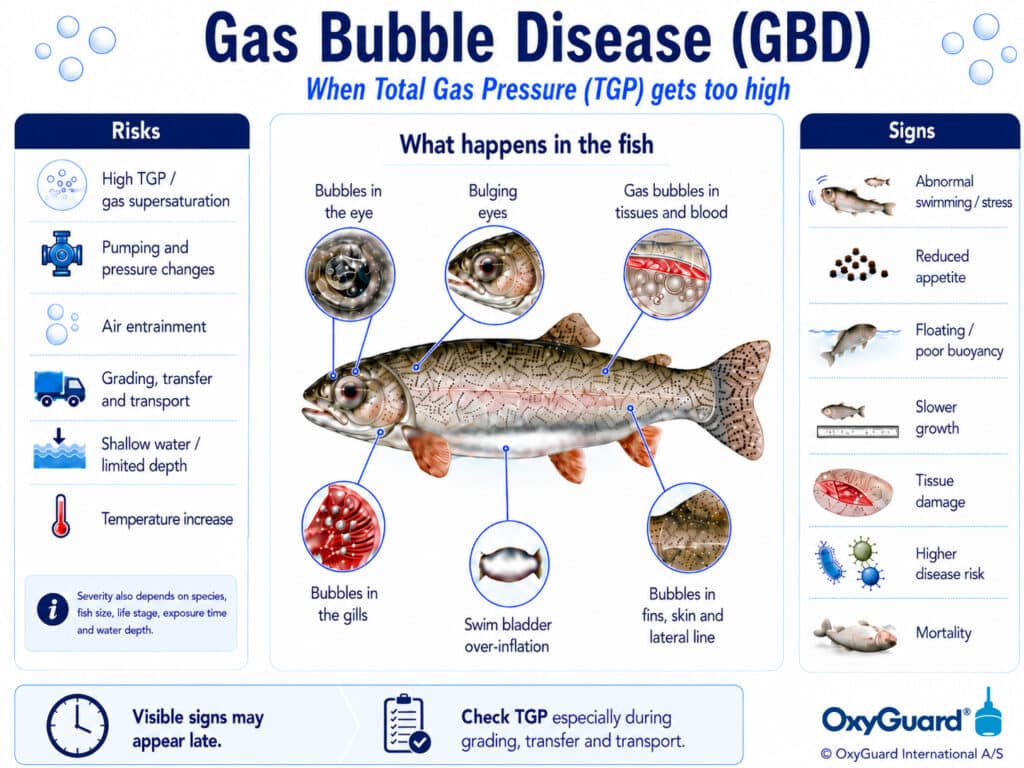
TGP is the combined pressure of all dissolved gases in the water, plus water vapour, usually expressed as a percentage of local barometric pressure. At 100 percent, water is in equilibrium with the atmosphere. Above that, it is supersaturated, and gases can start coming out of solution inside fish tissue, forming emboli, in a mechanism comparable to decompression sickness in divers.
The total pressure is an important warning sign, but the gas composition also matters. Nitrogen often deserves particular attention because it remains in the water, whereas oxygen is gradually consumed by the fish. That does not make oxygen supersaturation harmless: if TGP is high and oxygen uptake cannot keep pace, oxygen can also contribute to GBD. A fuller risk assessment therefore considers TGP alongside the partial pressures of oxygen, nitrogen and carbon dioxide, as well as temperature and hydrostatic pressure.
Dissolved oxygen can therefore remain within an acceptable range while nitrogen drives TGP upward, creating a false sense of security. The oxygen number may look fine, but the overall gas pressure can still be too high.
Handling creates a risk
Many fish farmers know that pump pressure, oxygen injection and hydraulic restrictions can raise TGP. The same risk is less often associated with grading and harvesting.
During these operations, fish are crowded into smaller areas, pumped through pipework, transferred between tanks or loaded for transport. Each step can introduce air or cause a change in pressure, exposing the water to conditions that differ from normal production. On a busy grading day with several transfers, small increases in TGP can build up without being noticed.
Transport presents an additional risk. Tanks are often smaller, stocking densities are higher, and oxygenation is more intensive. This combination can cause TGP to rise quickly. There is also less opportunity for excess gas to escape during transport than in a larger, static system.
Why you will not see it happening
TGP is tricky: the water looks normal, there’s no colour change, no smell, sometimes not even visible bubbles. Re-equilibration is also slow, so once TGP is elevated it can stay that way for days, well past the grading or transport event that caused it.
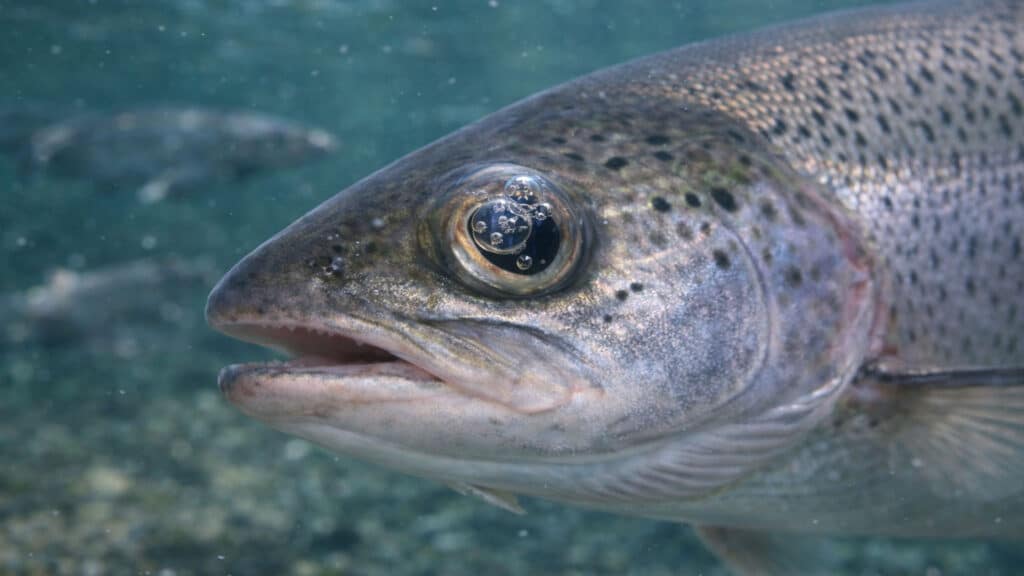
Visible symptoms often do not appear until well after exposure. When they finally show, they may include exophthalmia, gas emboli in the fins and gills, subcutaneous emphysema and erratic swimming. However, subclinical stress and internal emboli can be present without any visible signs, and in many cases, Gas Bubble Disease is only confirmed post-mortem. By the time you see something, the exposure has already happened, quite possibly during a grading run several days earlier.
It depends on depth, species and time
There is no single TGP value that guarantees trouble. Risk builds from three things together: how supersaturated the water is, how long fish are exposed, and how sensitive that species or life stage happens to be.
Depth matters because hydrostatic pressure works against bubble formation. In open water or a deep tank, fish can move down and get some relief. In a shallow grading tank, a transport tank, or a raceway, that option barely exists, which means even modest supersaturation can matter more than the same number would in a deeper system. Guidelines often cite 110 percent saturation as a threshold, but field observations put sensitive fish at risk from levels as low as 103 percent in shallow water, well below the level most producers would think to worry about.
Life stage matters just as much. Fry and fingerlings, with narrower physiological margins, tend to show stress at lower supersaturation and shorter exposure than market-size fish, which is why hatchery transfer and early grading deserve as much attention as harvest of larger stock. Larger fish are not immune, but they generally require longer exposure before showing similar effects. A long transport or a slow-moving grading day may provide exactly that.
What you can do about it
The first step is not complicated, but it does require measuring rather than guessing.
Start by measuring your TGP levels in different places and find out where TGP rises in your process. Not just in the tank, but at intake, after pumping, after oxygenation, and during and after grading, transfer or loading. Compare each reading against barometric pressure. This tells you whether gas is being forced into solution faster than it can escape, and where that is happening.
Even small changes in dissolved gas levels can matter, and the cause may be temporary or difficult to spot. Lars Fledelius Rickelt, PhD, marine biologist and chemical engineer at OxyGuard, explains: “Only a few % dissolved gas supersaturation (DGS) can cause gas bubble disease (GBD). It can evolve with a sudden rise in temperature or a malfunctioning pump. Especially nitrogen supersaturation is a problem, and it can only be detected by measuring TGP by a TGP-probe”.
This is why a normal oxygen reading alone is not enough. TGP measurement can reveal a broader gas imbalance that would otherwise remain hidden.
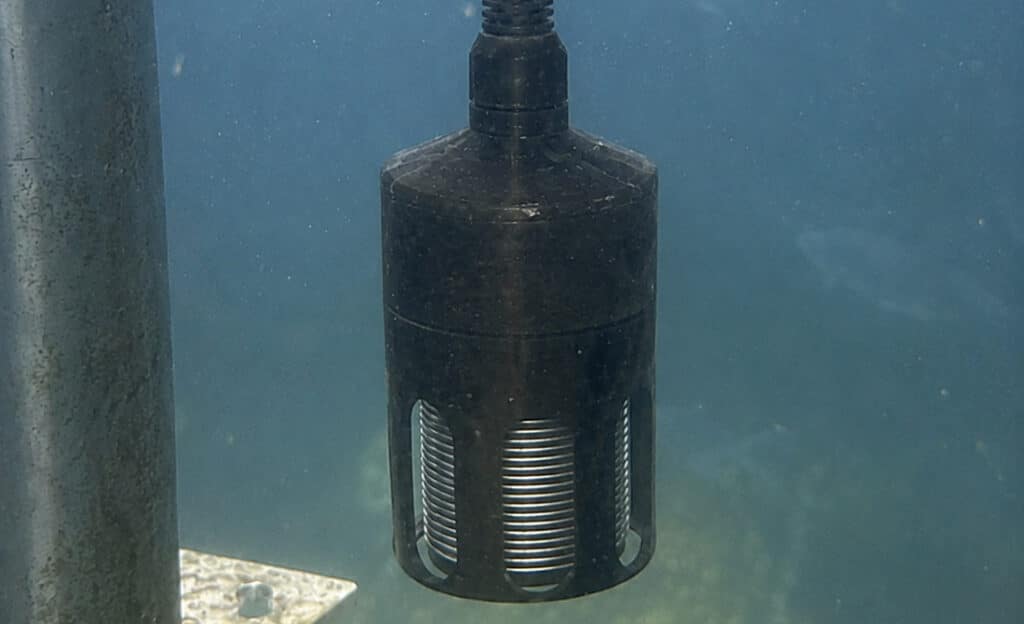
For routine production, a permanently installed probe gives continuous oversight in tanks or recirculation loops, catching drift before it becomes a problem. A hand-held meter is also handy in daily production, allowing you to spot-check TGP at different points in the system and add detail to the continuous picture provided by the fixed probe. During grading, transfer and transport, the same flexibility makes it possible to measure exactly where conditions change and fish are under the most stress.
Once you know where the imbalance starts, the corrections are practical: reduce air entrainment at pump suction, adjust oxygen injection pressure, improve degassing capacity, and remove unnecessary pressure or hydraulic restrictions, particularly around grading and pumping equipment that was not part of the original system design. Timing helps too. Where possible, spacing out transfers rather than running them back-to-back gives a system more room to release excess gas between batches, instead of stacking one supersaturation event on top of the last.
The bigger picture
It’s not only about avoiding one bad batch but also about knowing your water a bit better. As harvesting and grading get busier and RAS facilities push toward higher densities, fish move through more pressure-changing, oxygen-adding steps than ever, and each step is an opportunity for TGP to rise.
TGP monitoring deserves to become standard practice, much as dissolved oxygen monitoring did a generation ago. TGP doesn’t need to stay invisible. Reading the saturation makes you know your water better, and it pays off in healthier fish – and better numbers.
Written by Rikke Justensen, OxyGuard. Originally published in AquaFeed Magazine, September 2026.