

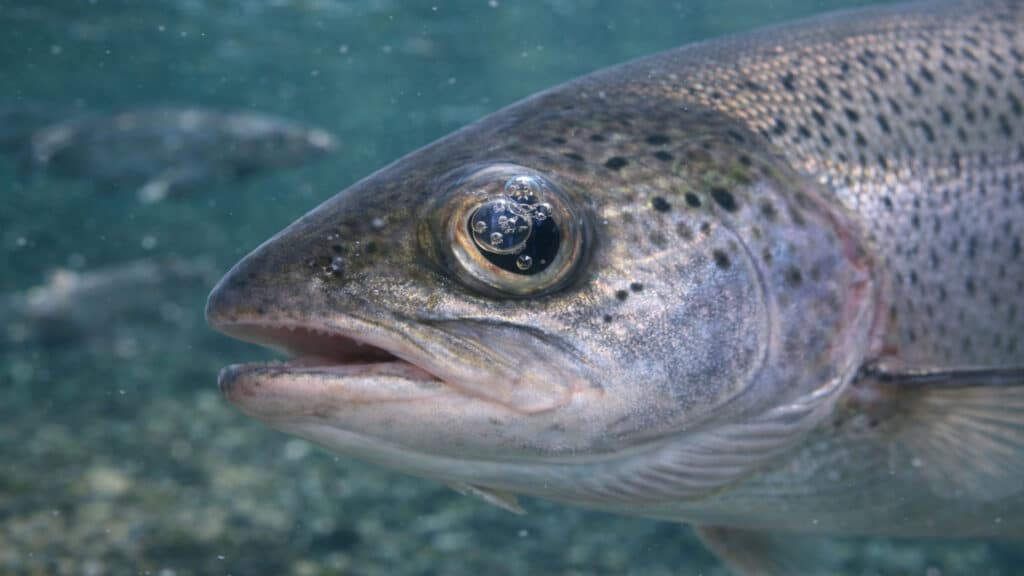
When does Total Gas Pressure become Gas Bubble Disease?
Gas Bubble Disease (GBD) develops when elevated Total Gas Pressure (TGP) persists for a duration and at a level that allows dissolved gases to form bubbles inside the fish.
A short or minor rise in TGP does not automatically lead to disease. GBD develops when the degree of supersaturation and the duration of exposure allow gas emboli to form in blood vessels and tissues. The transition from imbalance to disease depends on the degree of supersaturation, its duration, and how sensitive the species and life stage are.
This applies across all production stages, including hatchery and grow-out systems. Sensitivity varies between species and life stages, and early stages often have narrower safety margins, but larger fish are not immune if exposure is prolonged.
In practical terms, an elevated TGP becomes GBD when a physical imbalance in the water becomes a biological consequence inside the fish.
What a TGP probe measures
A TGP probe measures total dissolved gas pressure: the combined pressure of all dissolved gases in the water, plus water vapour. In aquaculture systems, nitrogen and oxygen are usually the dominant contributors, but carbon dioxide and other gases are also a part of the total pressure.
TGP is typically expressed as a percentage of local barometric pressure. At 100 percent, the water is in equilibrium with the atmosphere. When TGP exceeds barometric pressure, the water is supersaturated.
Under supersaturated conditions, gases can come out of solution inside fish tissues and form emboli, in a mechanism comparable to decompression sickness.
The critical point is that supersaturation is not reliably visible. Water can appear completely normal while TGP remains elevated. In some situations, bubbles may be seen on submerged surfaces, but this is not a dependable indicator. Because re-equilibration can be slow, supersaturation may persist for days, meaning fish can be exposed for extended periods before obvious clinical signs develop.
Most facilities monitor oxygen, temperature, pH and ammonia as standard practice. TGP can be overlooked, even though it is directly influenced by oxygenation strategy, pump pressure and hydraulic design. Without measurement, gas imbalance remains hidden.
How supersaturation develops in production systems
Elevated TGP can develop rapidly or gradually, depending on the cause. In many cases it results from pressure conditions that force gas into solution faster than the system can release it.
Typical sources include air entrainment at pump suction, oxygen injection under pressure, temperature changes that alter gas solubility, limited degassing capacity, and hydraulic configurations that create local high-pressure zones. Even relatively small imbalances between gas input and gas release can create persistent supersaturation.
It is important to know that dissolved oxygen may still appear within acceptable limits while nitrogen drives TGP upward. This can create a false sense of security. The oxygen number looks correct, but the TGP is not in balance. Without direct TGP measurement, a facility may operate under chronic supersaturation without recognising it.
Clinical signs of Gas Bubble Disease
When fish are exposed to supersaturated water, dissolved gases can form emboli in tissues and blood vessels. The clinical presentation depends on both exposure level and duration.
Typical signs include:
- exophthalmia caused by intra-ocular gas
- gas emboli in fins and gills
- subcutaneous emphysema
- altered buoyancy and erratic swimming
Gas emboli can impair circulation and, depending on exposure level and duration, result in mortality. However, the absence of clear external symptoms does not mean that fish are unaffected. Subclinical stress and internal emboli may already be present.
Why visible signs are not always the first indicator
Gas Bubble Disease is not always first identified through obvious external symptoms. In some cases, eye bubbles or subcutaneous gas are visible. In others, fish show only subtle behavioral changes, reduced feed intake, slower growth or unexplained mortality.
Internal emboli can develop before external lesions appear, and in some cases, GBD is confirmed only during post-mortem examination.
By the time visible signs are detected, exposure to elevated TGP may already have been prolonged. Visual inspection alone is therefore not sufficient as an early warning strategy. Measurement provides earlier insight into system imbalance.
Exposure time and risk
There is no fixed TGP value that automatically results in mortality. Risk is determined by the combination of supersaturation level, exposure time, species and life stage.
Depth plays an important role because hydrostatic pressure counteracts bubble formation. In open water, fish can often compensate by moving deeper. In shallow tanks and raceways, this option is limited, which means lower levels of supersaturation can still pose a risk.
Water quality guidelines for dissolved gas are often set around 110 percent saturation, but research and field observations show that lower levels can be problematic in shallow systems and for sensitive life stages. As a practical example, in shallow tanks, TGP as low as 103 percent has (in some cases) been associated with stress in sensitive fish.
As both supersaturation level and exposure duration increase, the likelihood of progression from physiological stress to clinical GBD increases.
Waiting for visible symptoms means that the biological impact has already occurred. Prevention depends on early detection and controlled system management.
What to do when TGP is elevated
When monitoring reveals elevated TGP, the objective is to restore gas equilibrium and eliminate the source of supersaturation.
Start by identifying where TGP increases within the system. Measure at intake, after pumping, after oxygenation and after degassing, and compare values to local barometric pressure. This helps determine whether gas is being forced into solution or insufficiently released.
Common corrective actions include:
- eliminating air entrainment at pump suction
- adjusting oxygen injection pressure and verifying adequate degassing
- improving off-gassing efficiency
- reducing unnecessary pressure and correcting hydraulic restrictions
The underlying principle is consistent: limit gas forced into solution and ensure excess gas can escape before fish are exposed for prolonged periods.
Continuous monitoring allows corrective measures to be verified in real time. When the underlying cause is identified and corrected, TGP will typically trend back towards equilibrium.
Making measurement of TGP part of the control routine
Supersaturation risk can be manageable because it is measurable.
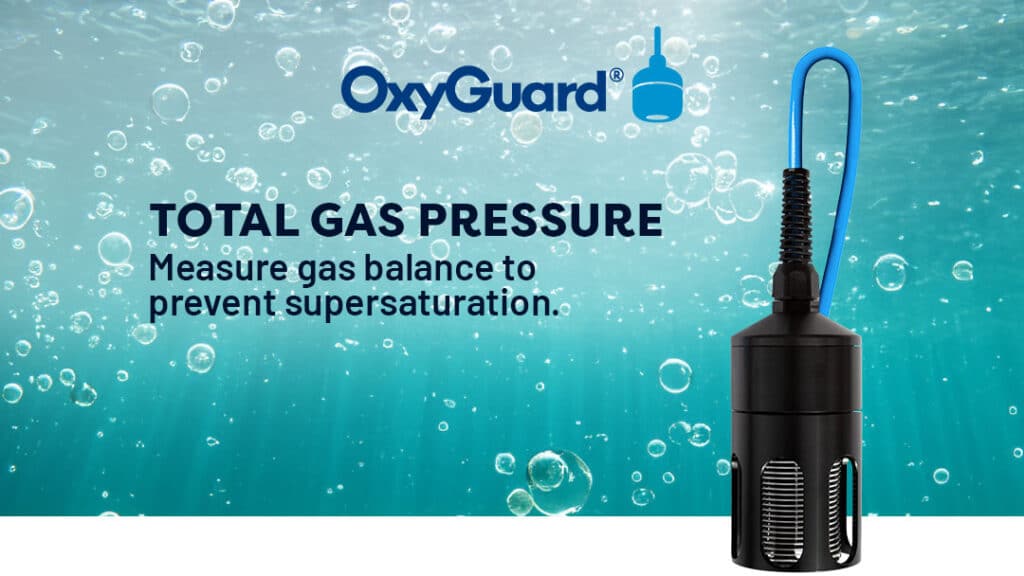
A permanently installed probe enables continuous monitoring directly in tanks or recirculation loops and provides early warning of system drift. The Stationary TGP Probe measures TGP continuously within the system, allowing operators to intervene before fish health is affected.
Mobile verification adds flexibility. The Polaris C TGP enables spot measurements in intake water, transport tanks or specific sections of the system, helping identify where TGP changes occur.
Fixed and mobile measurement together create both oversight and diagnostic capability. Without measurement, operators react to symptoms. With measurement, they control the system.
Implications for fish welfare and production
Gas Bubble Disease is not infectious. It reflects physiological stress caused by a physical imbalance in the water.
Supersaturation can affect swimming efficiency, tissue integrity and overall robustness. Even when mortality does not occur, performance may decline. Growth rates can decrease, behavior may change and fish may become more sensitive to handling.
In intensive systems, small performance reductions accumulate over time. Preventing supersaturation is therefore not only about avoiding acute losses, but about maintaining stable production, predictable outcomes and consistent biological performance.
From imbalance to control
TGP is invisible in the water, yet it can have significant biological consequences.
When TGP is measured routinely, supersaturation is detected before it develops into GBD, and corrective action can be taken early. This supports fish welfare, production stability and more predictable system performance.
With proper monitoring of Total Gas Pressure and informed system management, the risk of Gas Bubble Disease can be significantly reduced.