
AI-powered acoustic monitoring improve feeding
Read the article below or download the full article (PDF).
Feeding is where biology, farm economics and sustainability meet in aquaculture. Feed is often the highest operating cost on fish farms, and uneaten feed is a direct source of nutrient discharge. At the same time, feeding decisions are still largely based on experience, observation and fixed routines, even though fish behaviour changes continuously with temperature, oxygen levels, stocking density and health.
This has driven growing interest in technologies that respond to the fish rather than to a schedule. A PhD project led by OxyGuard, in collaboration with DTU, the Technical University of Denmark, is investigating whether acoustic monitoring combined with artificial intelligence can help interpret feeding behaviour in real production conditions. Instead of relying only on visual observation, the approach is based on listening to behavioural sound patterns in the water.
The project is currently in a PhD research and validation phase and is not a commercial solution today.
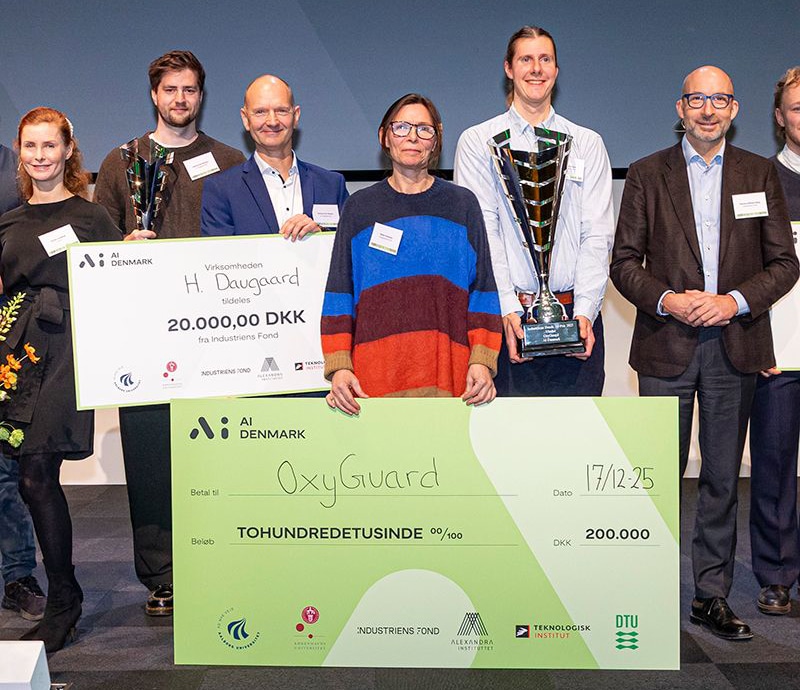
The work has recently been recognized with a prestigious AI Award from the Danish Industry Foundation. The award is given across sectors and industries, and the competition includes AI projects from fields such as health technology, manufacturing, logistics and green transition. For aquaculture, the message is clear. Advanced AI innovation is not limited to large global industries. It is also being developed in aquaculture, where the biological complexity and the operational stakes are high.
While the award highlights the relevance of the research, the core question remains practical. Can feeding-related behavioural signals be captured reliably on farms and used to support better feeding decisions, improved welfare and reduced environmental impact?
The PhD work, led by Martin E. G. Bertelsen, focuses on method development and testing. If the results are successfully validated and development progresses as expected, the work could form the basis of a commercial solution within the next three years.
“Feed is the single largest operating expense in fish farming and also one of the biggest environmental drivers. If we can help fish farmers distribute feed more precisely, we reduce waste, improve growth performance and lower environmental impact at the same time.” says Bertelsen.
Acoustic monitoring of feeding behaviour
Acoustic monitoring uses underwater microphones, known as hydrophones, to capture sound patterns during feeding events. In practice, the most distinct signals are the sound of fish snapping pellets and surface splashes. These signals change as feeding intensity rises or declines.
Compared with camera-based systems, acoustic monitoring is independent of light and water clarity. This makes it relevant in many production environments, including RAS facilities where visibility can be affected by bubbles and particles, as well as sea-based systems where turbidity and lighting conditions vary.
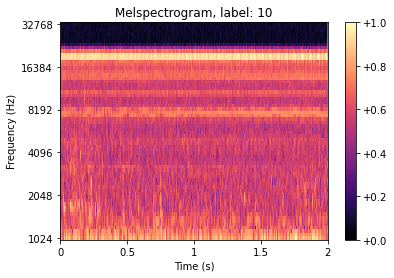
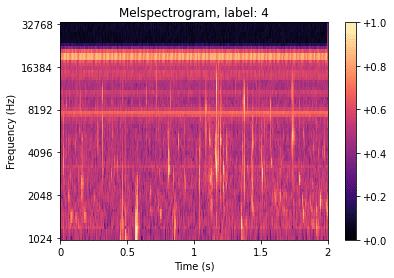
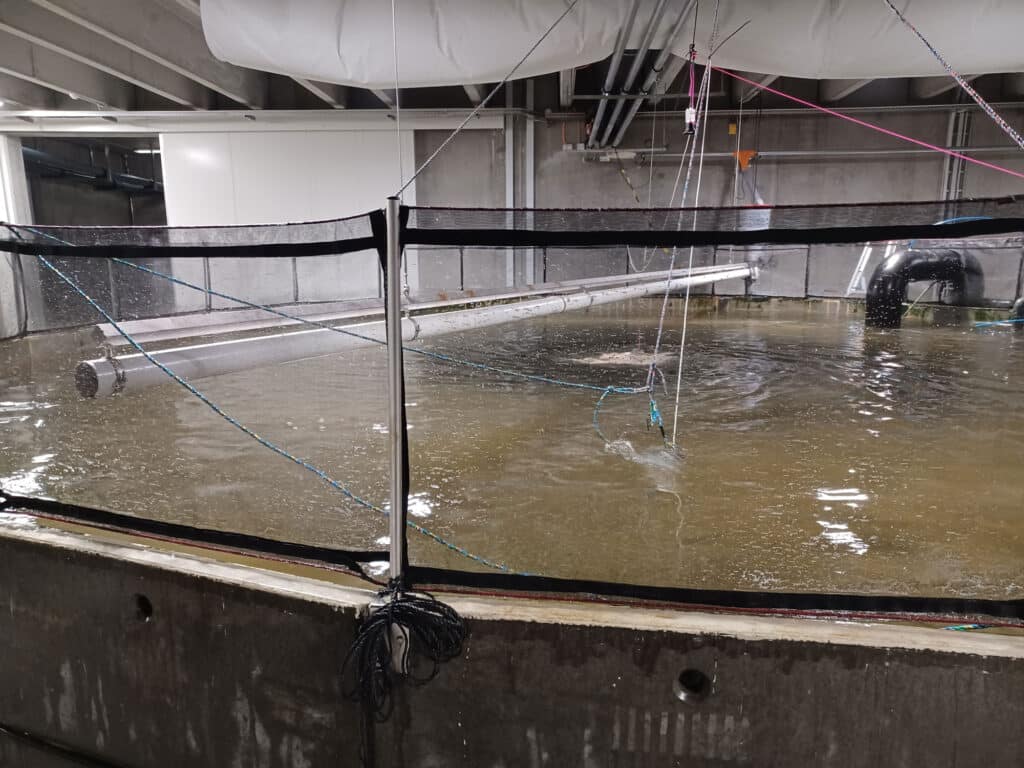
However, farms are acoustically complex. Pumps, aeration systems, water flow and feeders all contribute to background noise. One of the central challenges of the research is separating feeding-related sound patterns from non-biological noise and doing so in a way that remains reliable as conditions change.
This is where artificial intelligence becomes essential. By applying pattern recognition to acoustic signals and combining them with environmental data, feeding events and production parameters, the project aims to identify behavioural states such as active feeding, declining interest and satiety.
Importantly, acoustic monitoring is not intended to stand alone. Feeding sounds provide one layer of insight, while cameras and sonar are used to evaluate swimming behaviour and welfare indicators. The strength of the project lies in combining these data streams.
“Fish behaviour tells us a great deal, but interpreting those signals consistently in a busy production environment is difficult. Acoustic monitoring makes behaviour measurable continuously, and AI helps translate that information into insight that can support daily feeding decisions.” says Mette Frandsen, biologist and project leader at OxyGuard.
A key focus of the work is biological interpretability. The goal is not to build a black box, but to develop models that produce outputs that make biological sense and can be tested against real outcomes on the farm.
Feed savings and welfare benefits
Even small improvements in feeding precision can have a significant economic effect. Feed waste scales quickly in commercial production and feeding beyond the point of response represents a direct financial loss.
Behaviour-based insight is valuable because it addresses two daily questions faced by farmers: Are fish actively feeding right now, and when does the feeding response begin to decline?
If a system can help identify the optimal feeding window, it can support decisions on when to continue feeding and when to stop. The expected operational benefits include reduced feed waste, improved feed conversion ratio and more stable growth performance. In some systems, more consistent feeding strategies may also help reduce size variation by limiting extreme competition during feeding events.
Welfare is also an explicit focus of the research. Overfeeding can degrade water quality and increase biological load, which can affect welfare indirectly. But welfare assessment goes beyond water parameters alone. The project will also evaluate behavioural welfare indicators, including changes in swimming patterns, activity levels and acoustic signatures over time, to explore whether the technology can contribute to a broader welfare monitoring framework.
At this stage, it is important to be clear that these outcomes represent research objectives rather than guaranteed results. The PhD project is focused on testing whether behavioural signals are robust, whether they generalise across farms and species, and how accurately they reflect real feeding response under commercial conditions.
Feed waste reduction and sustainability
Uneaten feed is a major driver of nutrient discharge in aquaculture. In open systems, wasted pellets contribute to nitrogen and phosphorus loading and increase pressure on surrounding ecosystems. In RAS, feed waste raises the organic load in the system, increasing demands on filtration, water treatment and energy use.
Reducing feed waste therefore has immediate environmental benefits. When feeding is better aligned with appetite, less feed enters the water unused, supporting better water quality and reducing nutrient loss.
Lower feed use also reduces demand for feed ingredients and the environmental footprint associated with feed production and transport. Even small percentage improvements can have a meaningful impact when applied across large volumes of production.
As sustainability requirements increase globally, feeding precision is becoming more relevant not only from an environmental perspective, but also in relation to regulation, certification and market expectations.
AI in feeding management
AI is often discussed in broad terms, but in aquaculture, its value may be greatest in specific, repeated decisions made every day. Feeding is one of those decisions. It is frequent, costly and closely linked to welfare, growth and environmental performance. In the near term, AI is likely to play its strongest role as decision support. This means translating complex behavioural and environmental signals into clear, understandable guidance while leaving control with the farmer.
In the longer term, feeding management may move towards more predictive operation. Instead of reacting to what is happening now, models could anticipate growth performance and welfare dynamics over time, allowing farmers to plan feeding strategies proactively.
“The real potential of AI in aquaculture lies in combining biological signals into predictive frameworks that can be validated in real production. By combining data from multiple sensors with advanced models in a digital twin framework, fish feeding intensity can help predict fish growth, while fish size estimation in turn can be used to validate and refine the feeding intensity assessment.” says Bertelsen.
Such digital twin approaches require more than one data source. Acoustic monitoring may provide one behavioural layer, but growth prediction and welfare models depend on integrated data streams and a continuous feedback loop between model output and farm reality. This also raises new questions about data ownership, governance and farmer trust, issues that become increasingly important as AI solutions expand.
Research first, product later
Because the work is part of a PhD project, the current focus is on research and validation rather than commercial deployment. This includes collecting high-quality acoustic data, testing model performance across environments and validating behavioural indicators against biological outcomes. The collaboration with DTU, the Technical University of Denmark, strengthens the scientific foundation of the project and helps ensure the methods are developed and validated to a high research standard.
There is no commercial product available today. Developing a solution that can operate reliably across species, production systems and sites takes time. Based on the scope of the research and the need for real world validation, it may take up to three years before the technology is ready for commercial use.
If and when the research matures into a product, it is expected to involve dedicated monitoring equipment for acoustic data collection and digital tools for analysis and decision support. Behavioural insight would then be delivered through farm management systems and integrated into normal operational workflows.
“Our goal is to support fish farmers with tools that can be tested scientifically and deliver real operational value. If we can improve feeding precision while strengthening welfare assessment and reducing waste, it will be a meaningful step forward for the industry.” says Frandsen.
If behavioural sound patterns can be translated into reliable decision support, feeding may become one of the areas where aquaculture takes a real step forward, both in profitability and welfare assessment. It is a promising direction, and one that is well worth listening to.
The article was published in International Aquafeed.